
FISH
FISH
Kentucky Lake
& Lake Barkley
Understanding Ledge Fishing on Kentucky Lake & Lake Barkley
Kentucky Lake has long been known for its offshore bass fishing, particularly during the summer months when many anglers turn their attention away from the shoreline and toward the lake’s famous underwater ledges.
But if you’ve never tried ledge fishing, the whole idea might seem a little confusing.
After all, there’s no shoreline to cast toward, no visible point extending into the water, and often nothing above the surface to suggest fish might be holding nearby.
So what exactly are anglers looking for out there?
Understanding ledge fishing begins with learning what’s beneath the water, how bass use underwater structure, and why some ledges consistently produce fish while others don’t.
And once you understand those basics, fishing offshore starts to make a lot more sense.
What Is a Ledge?
A ledge is an underwater drop-off where the bottom transitions from relatively shallow water into deeper water.
On Kentucky Lake and Lake Barkley, many of these features are associated with the old Tennessee and Cumberland River channels and the creek channels that existed before the reservoirs were created.
When the rivers were impounded, those channels remained beneath the water, along with their bends, banks, points, and other natural features.
Today, anglers use those underwater contours to locate places where bass and other fish may gather.
Some ledges have relatively gradual slopes, while others feature steep drops into deeper channels. They might be found near the mouths of bays, along creek channels, or on the main river channel far from shore.
And while anglers often associate ledges with deep water, the important feature isn’t a particular depth.
It’s the change in depth and the underwater structure surrounding it.
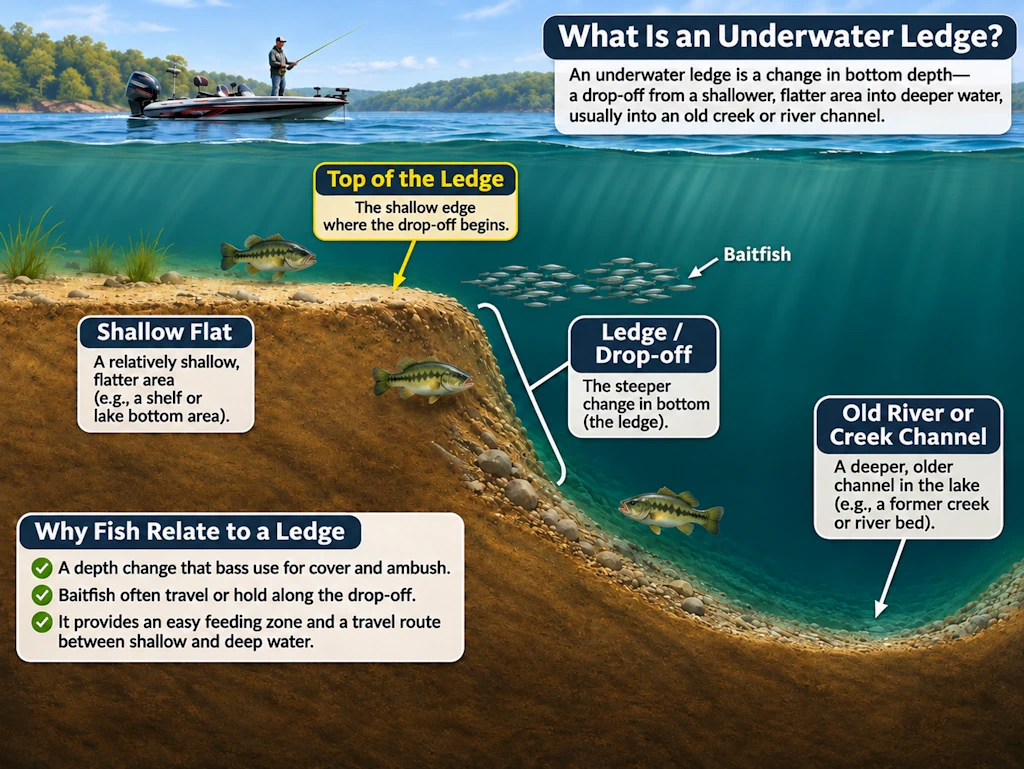
Illustration demonstrating what a ledge looks like. AGI.
Why Do Bass Use Ledges?
The late Dave Stewart, a longtime Kentucky Lake and Lake Barkley fishing guide, spent years helping anglers understand offshore fishing.
One of his most useful explanations was to compare old creek channels to underwater highways that fish use when moving between shallow and deeper water.
It’s a good way to visualize what happens beneath the surface.
Bass often move between different habitats as water temperatures, seasonal conditions, and available food change.
During spring, many bass move toward shallower spawning areas. After spawning, some move toward offshore structure, where river and creek channel ledges can provide access to different depths and feeding opportunities.
Similar changes can occur during fall as baitfish move into creeks and other areas.
But not every bass follows the same pattern.
Some fish remain shallow throughout much of the year, while others may spend extended periods around offshore structure.
The important thing is recognizing that ledges can provide convenient access to multiple depths, nearby forage, and areas where bass can position themselves to feed.
And that makes them worth investigating.
Not All Ledges Are Created Equal
One of the biggest mistakes anglers can make is assuming every drop-off will hold fish.
Kentucky Lake and Lake Barkley have miles of underwater channel edges, but some areas are considerably more productive than others.
The trick is finding the features that make one section of a ledge different from the surrounding bottom.
Look for Changes in Underwater Structure
Just as shoreline anglers look for points, pockets, rocky banks, and other features, offshore anglers should look for similar variations along submerged channels.
Some promising features include:
Channel bends: Places where an old river or creek channel changes direction.
Underwater points: Areas where a shallower section extends toward deeper water.
Cuts and indentations: Irregularities along a channel edge that interrupt an otherwise uniform drop-off.
Creek channel intersections: Locations where smaller channels meet larger creek channels or the main river channel.
Changes in bottom composition: Areas where mud transitions to gravel, rock, or harder bottom.
Submerged cover: Stumps, brush piles, stakebeds, and other objects that may attract fish.
A long, relatively featureless ledge might hold fish, but an irregular section with nearby baitfish and useful cover may offer a better place to begin searching.
And remember, structure and cover aren’t quite the same thing.
Structure generally refers to the physical shape and composition of the lake bottom, such as a channel bend, point, or drop-off.
Cover refers to objects fish may use for concealment or shelter, such as stumps, brush, or submerged timber.
Understanding that difference can help anglers narrow their search.
Finding Ledges with Maps and Electronics
Before heading out to fish offshore, spend some time studying a good lake contour map.
Modern digital mapping makes it easier to identify the old river and creek channels running throughout Kentucky Lake and Lake Barkley.
Look for contour lines that reveal changes in depth, particularly around channel bends, underwater points, and intersections.
Closely spaced contour lines generally indicate a steeper slope, while lines farther apart suggest a more gradual change in depth.
Once you’ve identified a few promising locations, the next step is investigating them on the water.
Using Modern Sonar
Today’s fishing electronics have made finding and understanding underwater structure much easier than it was years ago.
Traditional sonar and down imaging can help anglers examine bottom contours, identify fish, and locate submerged objects beneath the boat.
Side imaging allows anglers to scan areas off either side of the boat, helping them investigate a wider section of a ledge without passing directly over every feature.
Some anglers also use forward-facing sonar to observe fish and underwater structure ahead of the boat.
Of course, the equipment is only as useful as your ability to interpret what you’re seeing.
A screen showing a beautiful drop-off doesn’t necessarily mean bass are present.
Look for additional clues, including baitfish, isolated cover, changes in bottom composition, and fish holding near the structure.
And don’t overlook the value of simply fishing an area to learn more about it.
Let Your Lure Help You Explore
One of Dave Stewart’s favorite techniques for investigating offshore structure was dragging a Carolina rig along the bottom.
It’s an approach that still makes sense today.
As the weight moves across the lake bottom, an angler can sometimes feel the difference between gravel, rock, mud, and other features.
A Carolina rig may also help locate submerged cover that isn’t obvious on electronics.
Jigs and other bottom-contact presentations can provide similar feedback.
Modern sonar is valuable, but there’s still something to be said for learning what the bottom feels like through your fishing rod.
When you find a promising location, save it as a waypoint on your GPS.
Over time, building a collection of productive ledges and understanding the conditions under which they hold fish can be an important part of becoming a better offshore angler.
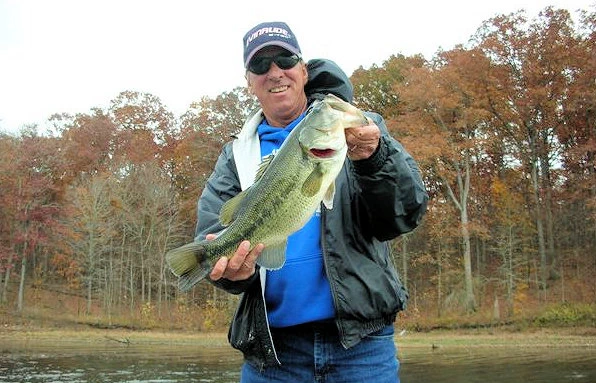
The late Dave Stewart, who contributed fishing reports to Explore Kentucky Lake from 2001 until his retirement in 2018, passed away in 2021. Dave was an outstanding bass fisherman.
How to Fish an Underwater Ledge
Once you’ve located a promising ledge, the next challenge is figuring out where the fish are positioned.
One useful approach is to begin on the shallower top of the ledge and gradually work toward deeper water.
Think of it like fishing a shoreline point, except the shoreline is underwater.
Bass might be holding on the upper edge, partway down the slope, near the bottom of the drop, or around a particular stump, rock pile, or other feature.
Where they position themselves can change with current, water temperature, light conditions, and baitfish activity.
Start at the Top
Begin by investigating the shallower portion of the ledge and the area where the bottom first begins to drop.
Depending on the depth and conditions, crankbaits, swimbaits, soft plastics, and other presentations can help determine whether fish are actively using the area.
If you’re marking bass or baitfish on your electronics, try to position the boat so your casts reach the area without unnecessarily disturbing the fish.
Sometimes bass will move onto the upper portion of a ledge to feed, particularly when conditions are favorable.
Other times, they may hold closer to deeper water.
Work Your Way Down
If the fish aren’t responding along the top, begin exploring the slope and deeper portions of the ledge.
Deep-diving crankbaits, football jigs, Carolina rigs, Texas-rigged soft plastics, and other bottom-oriented presentations can all be useful.
A deep-diving crankbait can cover water and help locate active fish, while a jig or Carolina rig allows anglers to work a particular area more thoroughly.
The best presentation depends on the depth, bottom conditions, current, and how the fish are positioned.
Don’t assume that a ledge needs to have an extremely steep drop to be productive.
Some fish may relate to gradual slopes, while others concentrate around sharper breaks or irregular features.
The objective is to determine which part of the structure the fish are using, rather than simply casting into the deepest water available.
How Current Affects Ledge Fishing
Current is one of the most important considerations for anglers fishing offshore structure on Kentucky Lake and Lake Barkley.
Water movement can influence how baitfish position themselves and where bass hold along channel edges, points, and other features.
When current increases, bass may take advantage of areas where moving water concentrates forage or creates feeding opportunities.
Some fish may position themselves near current breaks, such as the downstream side of a point, stump, or irregularity along the ledge.
These locations can allow fish to remain near moving water without constantly fighting its strongest flow.
But here’s something worth remembering.
More current doesn’t automatically mean better fishing.
Sometimes a modest amount of current can help improve the bite. At other times, fish may be difficult to locate or reluctant to feed despite significant water movement.
The location of baitfish, water temperature, season, and other conditions still matter.
Pay Attention to Dam Operations
Experienced ledge anglers often monitor generation schedules and discharge forecasts when planning their fishing trips.
The Tennessee Valley Authority operates Kentucky Dam, while the U.S. Army Corps of Engineers operates Barkley Dam.
Generation schedules can help anglers anticipate when water movement may change, while discharge readings and forecasts provide additional information about how much water is expected to move through the system.
It’s important to understand that discharge, measured in cubic feet per second (CFS), represents the volume of water passing a location, not the exact speed of current along a particular ledge.
And the same CFS reading won’t necessarily produce identical fishing conditions on Kentucky Lake and Lake Barkley.
If you’d like a more detailed explanation, our Understanding Water Levels & Current article covers seasonal lake elevations, dam discharge, generation schedules, and how anglers can use forecasts when planning their trips.
Boat Positioning and Casting Angles
Fishing offshore requires a little adjustment if you’re accustomed to casting toward the shoreline.
Because the structure is underwater, it’s important to understand where the drop begins, how it slopes, and where your lure is traveling in relation to it.
Boat positioning can make a difference.
For example, casting across a ledge may allow your lure to travel through several depths during a single retrieve.
Casting parallel to the drop-off may keep a lure near a particular depth or structural feature longer.
And when current is present, changing your casting direction can affect how the lure moves through the water and approaches fish holding near current breaks.
There isn’t one perfect boat position for every ledge.
Experiment with different angles and retrieve speeds, and use your electronics to help determine where the fish are holding.
A trolling motor with GPS anchoring capabilities can be helpful for maintaining position, especially when wind or current makes it difficult to stay on a particular spot.
Just be mindful of surrounding boat traffic, particularly when fishing near marked navigation channels.
When Is Ledge Fishing Most Productive?
Summer is most closely associated with ledge fishing on Kentucky Lake and Lake Barkley.
After the spring spawning period, many bass begin using offshore structure, making river and creek channel ledges popular places for anglers to search.
But ledge fishing isn’t strictly a summer technique.
Offshore structure can also be productive during other parts of the year, depending on fish movements, water conditions, and the availability of forage.
During fall, changing baitfish activity may bring bass toward creek channels and other areas connecting shallow and deep water.
Winter can also provide opportunities around deeper structure, although cold-water conditions may require slower presentations and a different approach.
And even during the peak summer ledge fishing season, don’t assume every bass has abandoned the shoreline.
Kentucky Lake and Lake Barkley can produce shallow-water and offshore fishing opportunities at the same time.
The most successful approach is to pay attention to the conditions rather than relying entirely on the calendar.
Putting It All Together
If you’re new to ledge fishing, don’t feel like you need to understand every underwater feature on Kentucky Lake or Lake Barkley before giving it a try.
Start with a manageable section of the lake.
Study your contour maps and identify a few channel bends, underwater points, or other promising locations.
Use your electronics to investigate those areas, paying particular attention to baitfish, cover, and changes in bottom composition.
Once you’ve found a likely location, work the ledge from shallow to deep, experiment with different presentations, and pay attention to current.
And don’t get discouraged if the first few spots don’t produce.
Learning to fish offshore takes practice, and even experienced anglers spend plenty of time searching for productive locations.
Dave Stewart understood something important about ledge fishing: many of the same principles that help anglers catch bass along the shoreline also apply to the underwater structure farther out in the lake.
The difference is learning to recognize those features without being able to see them.
Once you begin looking at Kentucky Lake and Lake Barkley that way, you’ll discover there’s an entirely different shoreline beneath the surface.
And there might just be a few bass waiting along it!

MORE FISHING
HOW'S THE BITE?
- Largemouth
- Smallmouth
- Crappie
- Bluegill Not Available
- Catfish Not Available
- White Bass Not Available
- Yellow Bass Not Available