Crappie
Without
a doubt the Crappie is the most sought after panfish in
North America. Kentucky Lake and Lake Barkley are
two of the top fisheries in the country for both numbers
and quality of these great eating fish.
Both Black and White Crappie are
taken here in good numbers through out the year by the
savvy angler although most anglers do not target them
during the summer months. The Crappie’s main
forage here is threadfin shad and insects.
SPRING PATTERNS
The spring Crappie fishing can be
broken down into three distinct phases: prespawn,
spawn and post spawn.
Early prespawn patterns begin when the morning water
temperatures are in the low 50’s which normally occurs
from early thru mid March. The Crappie will stage during
this period near the mouths of the creeks and bays along
the old creek and river channels as they prepare to move
toward spawning areas.
These staging fish can be taken
during this time by vertically fishing with small jigs
and small minnows. Two of the most popular techniques
used for this vertical fishing are “spider rigging” and
“bottom bouncing”.
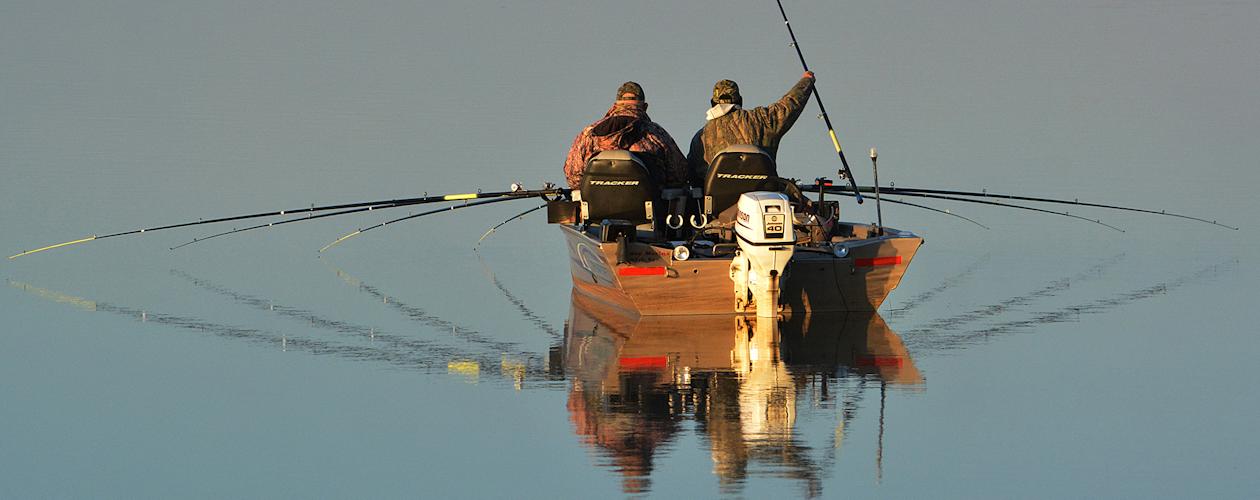
Spider rigging consists of the angler
using a number of long Crappie poles spread out to the
front and sides of the boat (hence the term spider
rigging comes from the analogy that a boat with all
these poles sticking out from it looks like a spider).
Each of these rigs are set at a
different depth by the angler as he moves along the old
ledges or over humps looking for schools of staging
fish. Once a fish is taken the angler makes note of the
depth that the fish was taken and adjusts the
accompanying rigs to this depth.
Bottom bouncing is a technique that
incorporates a rig that has the weight placed at the end
of the line and has one or more hooks or lures (jigs)
spaced above the weight. As the angler moves along the
old channel ledges he keeps slight contact with the
bottom by “bouncing” the weight along the bottom.
This is an effective method for
finding hidden cover such as brush piles, stake beds,
etc. that may be holding staging fish.
When the morning water temperatures
reach the mid to high 50’s the Crappie can be located in
the creeks and bays. These fish will generally be staged
over cover such as brush piles, stumps or deep stake
beds near the spawning areas. The White Crappie tend to
stage over the deeper cover but the Black Crappie will
tend to stage somewhat shallower.
These late prespawn fish are
typically taken by spider rigging with minnows or jigs
over the cover or by vertically jigging and/or casting
small curly tail jigs to the cover.
The spawning period normally begins when the morning
water temperatures reach the low 60’s and lasts for
about a week or 10 days. This normally occurs around the
first or second week of April. During the spawn the
Crappie can be taken in shallow water especially near
gravel areas with wood cover.
The best times to catch these fish
near the bank are early in the morning and late in the
evening. These spawning fish can readily be taken by
casting small curly tail jigs, small spinners to the
bank and retrieving or by fishing with minnows and/or
jigs under bobbers along the bank.
Typically during the day these
spawners can be taken around the nearest cover to the
spawning banks using the same methods but fishing
somewhat deeper.
Once the spawn is over, usually about
the time the morning water temperatures reach the mid
60’s, the Crappie will move back to the deeper water,
basically the same areas they used for prespawn staging.
It is important to note here that the
White Crappie will move to deeper water faster than the
Black Crappie. The Black Crappie will tend to stay in
shallower water near cover for quite a while longer than
the White Crappie as a general rule.
These post spawn Crappie are normally
tough to catch right after the spawn as they are spent
out from the spawning ritual and are sluggish.
However, they can be taken by spider rigging small jigs
(1/16 and 1/32 ounce) over the post spawn areas. Once
these fish have rested up they will start taking larger
jigs and minnows again.
SUMMER PATTERNS
When the morning water temperatures
move into the 70’s, which normally occurs here around
the middle of May the Crappie will move from the post
spawn staging areas to their deep water summer haunts.
These areas can be found along the
old creek and river channels. Typically, the fish
will be located in the 15-25 ft range. Most panfish
anglers don’t target the Crappie in the summertime as
they turn their attentions to other more active
summertime species such as White Bass and Bluegill.
But Crappie can still be taken in the summer by working
these deep water areas with bottom bouncing rigs and
spider rigging with minnows and jigs.
Night time Crappie fishing in the
summer can be very productive by fishing these areas
using lights to illuminate the surface of the water.
These lights will draw the insects to the area which in
turn draws the baitfish soon to be followed by the
predators and in this case the Crappie.
Many night time anglers are surprised
that they can catch Crappie near the surface at night by
using this method and by placing their lures or minnows
near the edge of the lighted areas. The Crappie will
remain in these deep water areas until the water cools
down sufficiently enough with the approaching fall to
move the baitfish into bays.
FALL PATTERNS
Fall Crappie fishing begins around
the first week in October as the morning water
temperatures drop to around 70 degrees. The baitfish
will then move into the bays to feed up for winter and
the Crappie will follow them to do likewise.
The fish will first show up around
the mouths of the bays near the old creek channel and
river ledges just as they do in the early prespawn
stages of spring. However, they will move into the
bays a little quicker than in the spring as the water
cools.
These fish may be taken by spider
rigging jigs and minnows and by vertically jigging over
deep cover along the old creek channels. As the water
continues to cool into the 60’s, one can expect the
Crappie to be well established in the creeks and bays.
They will be holding over cover along the old creek
channels with some Crappie moving to shallow water cover
near the shorelines and on the flats.
The deeper fish can be taken by
spider rigging and vertically jigging with jigs and
minnow. The shallower fish can be taken by casting curly
tail jigs, small spinners to the shallow cover and by
fishing around the shallow cover with minnows and jigs
under bobbers.
The fall fishing patterns will last
until the water temperatures drop to the lower 50’s,
normally around the end of November at which time the
baitfish and Crappie will move out to the deeper water
winter areas on the main lake.
WINTER PATTERNS
Many local Crappie anglers know that
winter time Crappie fishing can provide some very nice
catches of large fish for the angler willing to brave
the colder weather.
After the Crappie move out of the bays in late fall,
they will move back to the deeper water areas along the
old creek and river channels where they spent the
summer.
These fish are normally found in very
tight large schools suspended under schools of baitfish
along the channel ledges.
These fish can be taken by spider
rigging with small jigs and small minnows. The angler
should move slowly along the channel drop offs until
they encounter a school of Crappie. These fish will
normally be tightly schooled so it is important to not
move along to quickly.
Once a school of feeding winter
Crappie is found, an angler can expect a lot of quick
bites until the school moves off. The angler should be
very focused on their fishing during the winter as
usually the bite is very subtle.
Continue to
Largemouth >
Fishing 101 Credits:
Written by Dave Stewart,
Bass Buster
Guide Service
Edited by Shawn Dunnaway
Fishing 101 may not be reproduced or reprinted and is
provided exclusively by ExploreKentuckyLake.com
|